Best Undergraduate Project Award
University of Tehran School of Electrical and Computer Engineering, Project Day 2026. Awarded for the project later developed into my B.Sc. thesis.
B.Sc. in Computer Engineering · University of Tehran
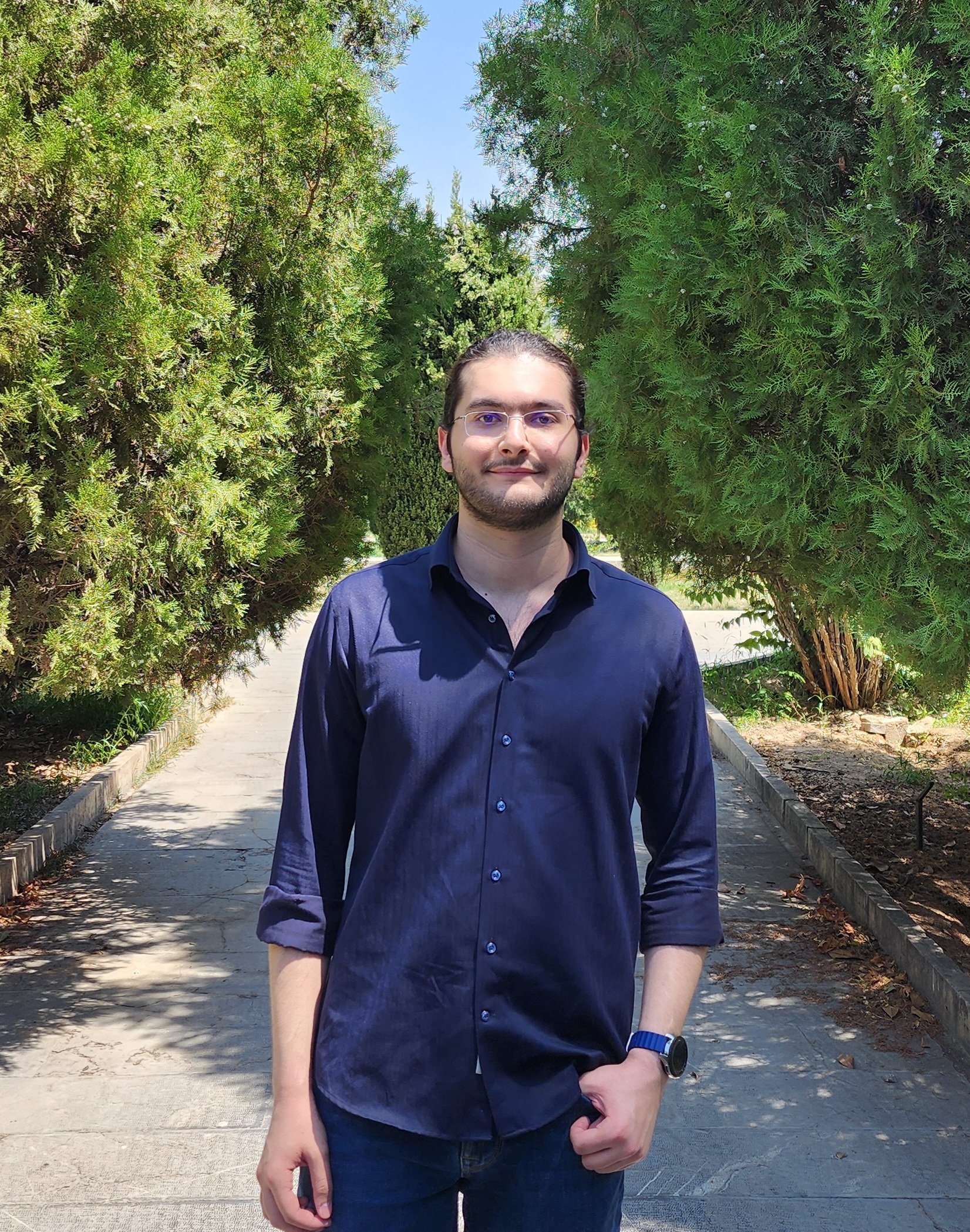
I recently completed my B.Sc. in Computer Engineering at the University of Tehran, with a concentration in Software Engineering. My GPA was 18.93/20, placing me in the top 5% of my cohort. My research focuses on reliable AI systems, AI for software engineering, computer vision and multimodal sensing, and AI in education.
I currently work at RastAI as a Full-Stack Developer and AI Engineer, building backend services, web interfaces, and AI components for a personalized learning platform. I also work on research in incremental code-quality review, post-earthquake building damage assessment, and evaluation of AI tutoring systems.
University of Tehran
B.Sc. in Computer Engineering, Software Engineering concentration
School of Electrical and Computer Engineering, College of Engineering
Sep 2021 - Sep 2026
GPA 18.93/20. Ranked among the top 5% of B.Sc. students in Computer Engineering.
English: full professional proficiency
IELTS Academic 8.0, CEFR C1 (Oct 2025)
Listening 9.0 · Reading 8.5 · Speaking 8.0
· Writing 7.0
Persian: native
University of Tehran School of Electrical and Computer Engineering, Project Day 2026. Awarded for the project later developed into my B.Sc. thesis.
University of Tehran. Recipient in the 2021-2022 academic year and nominated again for the award in the following cycle.
8th University of Tehran scholarship for talented students, 2022-2023.
Ranked in the top 0.5% nationally in the Iranian Nationwide University Entrance Examination.
Python, C, C++, Java, Kotlin, Go, JavaScript, TypeScript, SQL, MATLAB, Verilog, C#
PyTorch, TensorFlow, Keras, scikit-learn, OpenCV, YOLOv8, LangChain, Haystack, OpenAI Agents SDK
Spring Boot, Next.js, React, FastAPI, REST APIs, PostgreSQL, MongoDB, SQLite, Redis
Docker, Git, Linux, Kafka, MLflow, Langfuse, Jupyter, LaTeX, JUnit, pytest
My current research spans software engineering, disaster-response imaging, and AI tutoring. Across these projects, I focus on evaluation: whether a system's output is accurate, traceable, and useful for the person making the next decision.
I expanded an undergraduate software-engineering project into my B.Sc. thesis, developing a Git-based workflow for incremental code-quality review using large language models to support human evaluators. The workflow combines project requirements, evaluation criteria, domain documentation, and code changes with evidence validation and traceable reporting. I evaluated it on real Java and Go projects and compared different ways of providing project-specific context.
I study building-level damage assessment from pre- and post-earthquake remote-sensing imagery to support faster identification and prioritization of affected structures after major earthquakes. The goal is to support faster field inspection and resource allocation during disaster response. I designed and evaluated an approach that first identifies affected buildings and then estimates damage severity. Across four earthquake events and 373 test tiles, it reached affected-building precision and recall of 61.07% and 33.81%, compared with 53.66% and 25.98% for the reference baseline on common support.
I design LLM-simulated Persian student personas with bounded knowledge, stable misconceptions, confidence, engagement, and help-seeking behavior to test AI tutoring systems before enough real student dialogue is available. I also built a 5-10-turn LMS evaluation workflow that records conversations and session metadata to assess persona consistency, misconception stability, and tutor responses across student profiles. The resulting dialogue data supports controlled evaluation and future personalization.
I develop Kotlin and Spring backend services, Next.js and React interfaces, and Python AI components for an LLM-powered personalized learning platform. I also build AI-assisted learning workflows covering API integration, tracing, evaluation, and observability, and work with the product team to turn learning requirements into implementable system designs.
I built Python computer-vision applications covering image processing, OCR, classification, object detection, pose estimation, and segmentation using OpenCV, MediaPipe, EasyOCR, YOLOv8, scikit-learn, Segment Anything, Streamlit, Stable Diffusion, and DeepFace.
Programming assignments, tutorials, and homework and exam grading across the following courses:
A selection of public course projects and paper reproductions. Each title links to the corresponding repository.
LoRA fine-tuned the 8B-parameter LLaDA masked-diffusion model for Text-to-SQL and implemented its iterative sampling loop from scratch, reaching 17.3% normalized exact match on 300 held-out queries. Also reproduced work in plant-disease classification, brain-MRI segmentation, and variational autoencoders.
Implemented RPC services, MapReduce, Raft consensus, and sharded key-value stores in Go with tests and documentation based on MIT 6.5840/6.824-style labs.
Built a real-time surround-view simulator with interactive calibration, an image-stitching path measured at approximately 23 ms per frame, and support for embedded deployment.
Built a content-based KNN recommendation pipeline covering exploratory analysis, feature engineering, reproducible data processing, experiment tracking, persisted model artifacts, and dashboarding.
Extended a trading matching engine across several iterations with asynchronous messaging, new order types, automated tests, and design-pattern-based restructuring.
Built an automated osu!standard beatmap-generation tool that combines BPM and offset detection, pretrained deep-learning map generation, and post-processing to produce playable .osu maps, with both GUI and CLI workflows.
If you want to talk about research, software, or one of the projects above, email is the easiest way to reach me.